
FEATURE - The pipes are always calling
- Ronalyn

- Mar 9
- 7 min read
Wendy and Gordon Ferguson’s story entwines Glasgow, Brisbane, ballet, bagpipes and even the James Bond parody, Casino Royale!
by Louise Tasker


Down a long driveway, tucked away in a replica Queenslander, live Gordon and Wendy Ferguson. I sit with a cup of tea and a slice of Wendy’s 90-year-old mum’s delicious fruit cake and attempt to capture their lives on paper.
Wendy and Gordon arrived in Montville 15 years ago. Gordon has become well known across the Range as the piper to call on for events like ANZAC Day.
Gordon says, “Did you know that Gordon is not my first name? It’s really Forbes. Forbes Gordon Ferguson.” We joke and say it’s a lawyer’s name.
Wendy is Brisbane-born and bred, having been brought up in an inner city suburb in the 1960s. There were five children and her mother and father and they lived in a house with three bedrooms, one bathroom and a backyard toilet.
“It was an average suburban childhood,” she says. “We played on the road outside, everyone knew each other, we walked to school, played tennis, did ballet. And each year we had a beach holiday.”
Her father was a self-employed electrician and when her brother was old enough, her mother went to work
Gordon’s childhood was quite the opposite. Gordon lived in the top floor flat of a tenement in Rutherglen, on the outskirts of late 1940s Glasgow, with two older sisters and his mother and father.
The flat had only one bedroom and Gordon shared this with his two sisters until they became young teenagers. His parents slept in a curtained-off bed recess in the lounge. When Gordon moved out of the bedroom, he slept in a bed cabinet in the lounge. Yes, the same room as his parents. The bed cabinet was a piece of furniture incorporating a bed, which pulled down to be slept on, but in the morning had to be pushed back up and the cabinet shut.
When Gordon’s father had a very bad accident and was unable to work again, Gordon’s mother became the sole bread winner, buying a corner store below their tenement flat. Mr Ferguson helped out with tidying the flat, preparing meals and making many cups of tea for his friends who were always dropping into the back of the shop for a laugh and a chat with him.
Encouraged by his father, Gordon has been playing the pipes since he was nine years old. A young piper does not learn on miniature sized pipes but on a practice chanter, which helps the student to master the fundamental finger positions, scales and embellishments necessary for piping.
At age 11, he progressed to adult sized pipes but he was so small that in order to hold the instrument he had to put his head between the drones, which his sisters thought was hysterical.
Gordon left Rutherglen Academy at age 15 to work as a commercial apprentice with Stewarts and Lloyds, international steel pipe manufacturers. They sent him to college one day a week and he attended night school, passed all high school certificates and started his studies as a chartered secretary.
As the years passed, Gordon became an expert piper and he has played with many world famous pipe bands, travelling with them to Europe, Russia, Canada, New Zealand and of course Scotland for various tattoos.
Gordon said, “I never would have thought as a kid just starting out that so many doors would be opened – everywhere you go, there is always someone somewhere who plays the pipes.”
In 1967 Gordon was playing with world champions Muirhead and Sons Pipe Band when, along with four other top Scottish bands, they were invited to Shepperton Studios in London, where the spy parody film, Casino Royale, starring David Niven and Ursula Andress was being filmed.
“We marched into Shepperton Studios, pipes playing All The Blue Bonnets Are Over The Border. Everyone stopped what they were doing (perhaps wondering if Bonnie Prince Charlie had returned!) and I was walking on air. I couldn’t believe that I was playing for a movie with famous actors.”
Gordon is a true Scotsman and yet he travelled 10,000 miles across the world to a very different country. Two things brought him here: a New Zealand teacher whose adventuring stories about his own country tallied with Gordon’s desire, even as a child, to always want to see what was around the corner and over the hill. And of course, the weather!
“It was the first of June and I had to sit an exam. We were living in the Highlands and I opened the door to find everything covered in an inch of snow. It was the first day of summer! Madness!”
His wife Margaret applied to the Australian Government in 1980 to emigrate and they were successful. They had lived in Newcastle for three years in the very early 1970s but after their first son was born, homesickness and a desire to show off their bonny sun-kissed baby took them home.
Nine years later, the inch of snow weighed too heavily and finally they returned down under for good, now with a family of five children!
“I really miss the Scottish traditions though. Events like the Highland Games, Burns Nights, and Ceilidhs for instance.” Gordon is excited to be recreating one in the Montville Village Hall in May.

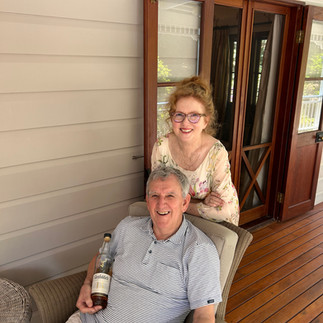


After Margaret passed away, Gordon met Wendy unexpectedly at a fundraising meeting between the consultancy Wendy then worked for and the Boys’ Brigade which Gordon was involved with. When they married in 1997, Wendy went from no children to five children, and eventually nine grandchildren, and her favourite 1970s music has ever since been overlaid with the many piping tunes that Gordon likes to play around the house.
Wendy says wryly it all sounds the same and, in fact, an old friend of Gordon’s once told him Gordon only ever plays two tunes. “You’ve got to be joking I said,” Gordon says in mock horror, “There are marches, strathspeys, reels, jigs, hornpipes, slow airs, pibroch! (The pibroch is the original classical Scottish music that dates back to the 16th century.)
“When can you come for a lesson?” he laughingly asks me, as he shows me a book of Scottish laments, all with very odd titles!
Perhaps to be expected, Gordon usually wakes up with a pipe tune in his head. He has written one composition – it started on the Isle of Mull and he’s nearly completed it. I’m sure we can find somewhere for him to premiere it. Maybe at May’s Montville Ceilidh?
Wendy is now a counsellor. She says, “It’s a very privileged position to be in and that’s why I completed my Masters in Counselling. I wanted to be a counsellor, rather than a counselling psychologist, and this is what I still do. It’s work I absolutely love.
“But,” she continues, “if I had my time over again, I’d be a race car driver. The best gift Gordon ever gave me was eight laps of Queensland Raceway.”
Wendy and Gordon both love their community. Wendy says community is “one of the mental health protective factors. It’s so important to find that connection somehow, maybe via the school or an art group or the church. It’s much easier to then become part of a community than if you wait for people to come to you.”
Perhaps because she’s a counsellor, she loves talking deeply to people rather than skimming the surface. She finds that other people’s lives can be so inspirational.
This is also where Wendy’s philosophy in life comes from: decide how you would like to be treated by others and then be that person for other people.
They both enjoy reading – fiction, non-fiction, historical novels or biographies. Gordon likes reading about the real life stories of heroic people fighting with great humanity against the odds, such as Matthew Flinders and Ernest Shackleton, both explorers.
Such heroics however were not needed to bring them to the Range. Gordon says, “When the kids were young we were told about the Mapleton QCCC which was run by the Baptist church at the time. We could get a dormitory with double bunk beds and have a proper holiday.”
The children would be away all day playing games and Gordon and Margaret could read and swim and have a low-stress holiday.
Gordon continues, “I always had in the back of my mind that I wanted to move out of Brisbane and live within a two-hour distance of Brisbane and near the coast, with some woodland and country and views, and Wendy was up for it too, so when this house came up it ticked all the boxes.”
Wendy has her own early memories of 1980s Montville.
“I used to come up and visit The Pottery in Main Street. There was a café and we would have lunch there and enjoy the views. We could watch the potters as they worked. It was beautiful.” (The Pottery was an old Queenslander house that was pulled down in 1998 and the Pottery Building was built which now houses shops like the Opalcutter.)
They have no hesitation in saying that they prefer village life to living in a suburb. Wendy says “Montville is so unique and I really hope it stays that way. It’s a mountain village and that’s why we came here. I love the massive canopies of the big dark tree tunnels.
“Gordon says living here reminds him of the village in the Highlands – there it could take half an hour to buy a loaf of bread, because there was always someone to chat to along the way.”
I wondered what is the best piece of advice they have ever been given. Wendy was young when her mother told her, apropos of nothing, to never repeat to anyone what someone else has said about them. Keep it to yourself. It’s stood her in good stead.
Gordon said, “Faint heart never won fair lady. And dinnae fash yersel. The first is pretty obvious and the second means don’t get stressed about the small things.” Surely that’s a good piece of advice for these times?
I was sorry to say goodbye at the end of our talking marathon and, really, there is still so much to know about these two generous-hearted people. That’s life though, isn’t it? There is always so much more to everyone’s story.


Comments